

It was not a language that made humans emerge from the animal kingdom, but its mathematization.
Trialistic Cosmology
Syncretic Copernican (anthropodecentric) Three-world-doctrine
For all those, for whom the idea with the spaghetti monster is not completely satisfactory.
Based on the consideration of a multitude of paradoxes and inspired in particular by Roger Penrose's book "Shadows of the Mind: A Search for the Missing Science of Consciousness" from 1994, this three-world doctrine is in a way a farewell to the hope of finding an intellectually justifiable world view with a compact and consistent basis. In particular, this would mean that it is not possible to formulate a consistent theory of quantum gravity, and therefore no world formula. In this respect, it is also a synthesis of externalist and internalist theories and, as such, to a certain extent a meta-religious system. A well-known example of a trialistic constellation is Hegel's dialectical logic of thesis, antithesis and synthesis. If one assigns the thesis and antithesis to Descartes' and Plato's worlds respectively, the synthesis consists of all three worlds together. Or, to put it another way, this cosmology can be described as a hegelized Allsynthesis, based on the insolubility of the problem of universals.
From a philosophical perspective, this is a holistic cosmology with a minimal metaphysics that attempts to give form to the paradoxical fundamental structure of the world. More precisely, it is a holistic metaphysical system in which the cosmos is described not as an organic whole but “merely” as a metaphysical whole. It thus stands in contradiction both to reductionist cosmologies, which consider only experimentally falsifiable physical laws to be valid, and to esoteric cosmologies, for which hardly any evidence is required for the selection of their laws. In other words, neither reductionist nor esoteric cosmologies meet my (mathematical) criteria for evidence. Historically speaking, Nicolaus Copernicus unsuccessfully attempted to limit the negative consequences that his anthropodecentric worldview had for metaphysics. The subsequent triumph of astrophysically reductionist views of reduced cosmologies was likely not his intention. With similar intentions, Isaac Newton also spent most of his time engaged with alchemy and its metaphysics.
| Descartes world | Hume world | Plato world | |||
| Functionalism, Physicalism | Skepticism, Constructivism | Platon-, Pragmat-, Idealism | - philosophical views | ||
| undirected | directed | virtual | - Question about the time | ||
| nonfree | transactionalistic | free | - Question about the will | ||
| virtual | mortal | immortal | - Question about the soul | ||
| Formalism, Deductivism | Intuitionism, Constructivism | Platonism | - mathematical views | ||
| Classical logic |
Intuitionistic logic, Modal logic |
Paraconsistent logic, Quantum logic |
- Logic |
||
| General relativity | Thermodynamics | Quantum mechanics | - Physics | ||
| atoms, relations, sets | multisets, lists, trees, graphs | objekts, classes | - Data structures | ||
| syntax | semantics | pragmatics | - Semiotics | ||
| Symbolic AI | Artificial neural network | Embodied AI | - Artificial intelligence |
As a good metaphor for the Three-world-doctrine works the Riemann sphere. The following equivalents apply to this:
Plato world = P(∞)
Descartes world = P(0)
Hume world = all P(x) for x ∈ ℂ \ {0}
The points x ∈ ℂ of the complex number plane are mapped to the intersection points P (x) of the lines through P (∞) with the number sphere on them.
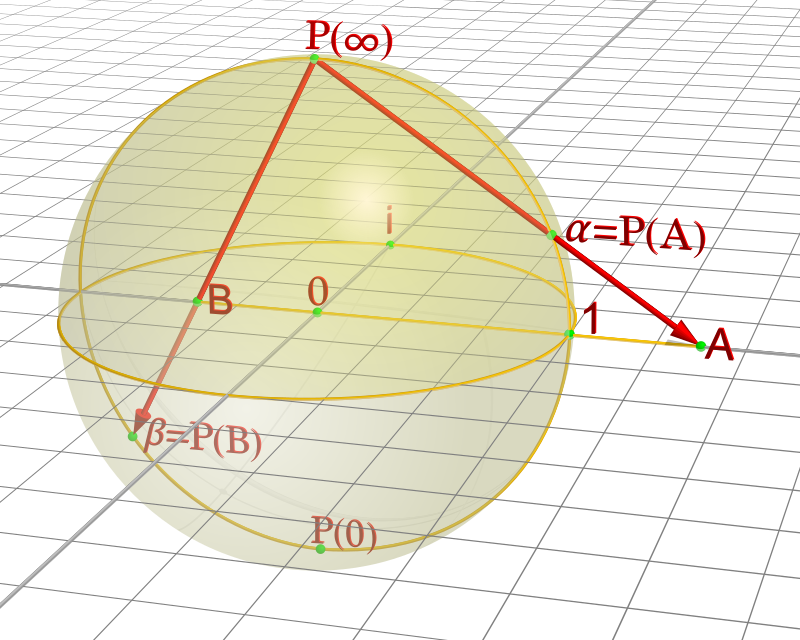
Following this metaphor, one could say that the Descartes world P(0) as a kind of origin with the Plato world P(∞) as an Archimedean point together spans the Hume world. So the Hume world is the world we live in, but it would not exist without the other two. Compared to other Three-world-doctrines one could relate the Plato world to the world of the logos, but a separation between physical and mental worlds is not purposeful from a neutral monistic point of view.
Mathematically, a Riemann sphere is a topological space and as such a compactification of the complex plane. By adding the ideal point P(∞), the infinite plane surface becomes a finite sphere. P(∞) represents in a certain way the infinity of the complex plane, and makes this by the compactification somewhat more controllable and more vivid.
The question of what is real remains difficult. It can be considered separately for each of the three worlds. The following table shows what I consider to be the five most common and eleven other points of view:
| Descartes world | Hume world | Plato world | |
| irreal | mystical | real | - Theists |
| irreal | real | mystical | - realistic Agnostics |
| irreal | irreal | mystical | - constructivistic Agnostics |
| real | mystical | irreal | - Atheists |
| mystical | irreal | irreal | - constructivistic Atheists |
| irreal | irreal | real | - fundamentalistic Theists |
| irreal | real | irreal | - Amoralists |
| real | irreal | irreal | - fundamentalistic Atheists |
| irreal | irreal | irreal | - radical Constructivists |
| mystical | mystical | real | - theistic Mystics |
| irreal | mystical | mystical | - constructivistic theistic Mystics |
| mystical | real | mystical | - realistic agnostic Mystics |
| mystical | irreal | mystical | - constructivistic agnostic Mystics |
| real | mystical | mystical | - atheistic Mystics |
| mystical | mystical | irreal | - constructivistic atheistic Mystics |
| mystical | mystical | mystical | - trialistic Mystics |
The remaining 11 combinations are dissociative, magical, or otherwise dysfunctional; in other words, viewing two worlds as real at the same time, for example, can only be detrimental to one’s mental health. Real amoralists — who are more than mere anti-moralists — are rare. Radical constructivists claim to want to completely dispense with the concept of reality. In practice, however, this is not feasible. From a trialist point of view, all three worlds are somehow simultaneously real and irreal (imaginary, virtual) and therefore mystical. But it could also be completely different. Wittgenstein I see most as a mystic. The early one as an atheistic and the late one as an agnostic. With Kurt Gödel I am unsure whether I see him as a trialist mystic or, like most mystics, as a theistic one. My worldview somehow oscillates between that of an agnostic and that of a trialist mystic.
Bibliography
Lee Smolin: The Trouble with Physics, 2006
Lee Smolin: Time reborn – from the crisis in physics to the future of the universe, 2014
Peter Woit: Not Even Wrong: The Failure of String Theory & the Continuing Challenge to Unify the Laws of Physics, 2006
Roger Penrose: Shadows of the Mind, 1994
Sabine Hossenfelder: Lost in Math: How Beauty Leads Physics Astray, 2018


